


Sunday’s Top Stories:
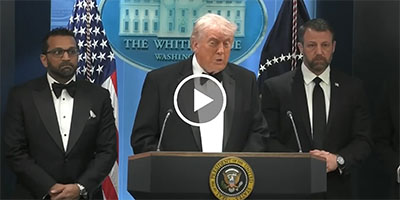
VIDEO OF THE DAY: Trump gives pathetic and all-too-predictable response to White House Correspondents’ Dinner attack
Speaking just hours after a lone gunman reportedly fired multiple shots and was apprehended outside the Washington Hilton Hotel ballroom where the annual White House Correspondents’ Association dinner was being held last night, Donald Trump decided to spin the affair into — why not — a sales pitch for his $400 million dollar ballroom. In other words, there’s actually a beneficiary to this disaster, and, wouldn’t you know it, it’s Donald himself. The self-important man-child is nothing if not consistent in taking the wrong lesson from literally every situation.
And not for nothing, the right-wing messaging machine was primed and quick to spring into action.
Take Action: Demand Congress pay for healthcare, not war!
The Justice Department sides with the Ku Klux Klan
Matt Ford, The New Republic: “The United States did not always have a Department of Justice. President Ulysses S. Grant founded it in 1870 to help suppress the Ku Klux Klan in the Southern states and enforce federal civil rights protections for formerly enslaved Americans. On Tuesday, Justice Department officials announced what may be the first Klan-friendly prosecution in the department’s history. The Southern Poverty Law Center, or SPLC, is one of the most influential civil rights groups in the nation. Founded in 1971, it has spent the last five decades monitoring, documenting, and exposing hate groups and violent extremists. The group rose to national fame in the 1980s by financially breaking the modern Klan through strategic lawsuits on behalf of its victims. Trump Justice Department officials struck a much different note about the SPLC’s work when announcing the indictment. Acting Attorney General Todd Blanche claimed on Tuesday that the SPLC was ‘manufacturing the extremism it purports to oppose by paying sources to stoke racial hatred.’
“The SPLC is manufacturing racism to justify its existence,” Blanche later said in a press release. ‘Using donor money to allegedly profit off Klansmen cannot go unchecked. This Department of Justice will hold the SPLC and every other fraudulent organization operating with the same deceptive playbook accountable. No entity is above the law.’ According to the indictment, the SPLC “explicitly sought donations under the auspices that donor money would be used to help ‘dismantle’ violent extremist groups.” Instead, the indictment claimed, SPLC donors “were not told that some of the donated funds were to be used by the SPLC to pay high-level leaders of violent extremist groups,” as well as for similar undercover purposes. There are a few problems with this theory of fraud. First of all, the SPLC was not paying members of these groups to provide material support to their activities or out of ideological sympathy. They were cultivating informants who could provide damaging (or even basic) information about extremist groups, their members, and their operations, thereby furthering the SPLC’s goals of “dismantling” those groups. Prosecutors were fully aware of this because they describe it elsewhere in the indictment. Second, it was hardly a secret to the public or to donors that the SPLC used undercover sources.
Nor was any of this news to the federal government. Law enforcement agencies routinely worked with the SPLC to track and monitor hate groups. This looks like an intentional effort to financially damage or destroy the SPLC as an organization, rather than merely punish specific offenses. There is a long history of Klan denialism in this country that minimizes the actions of violent white supremacists, often by blaming their actions on their victims and opponents. It is horrifying to see the Justice Department, whose original mission was to fight the Klan, engage in similar denialism.”

Conservation Law Foundation takes the fight to Donald Trump and the fossil fuel industry
Conservation Law Foundation: The real battle for our planet, our environment, and our public health takes place in the courtroom. Stopping Trump from ruining our clean air, our clean water, and all the progress we’ve made hinges on Conservation Law Foundation’s legal team winning big fights behind the scenes — like their 14 MAJOR lawsuits currently underway against the Trump administration. But they don’t have the war chests that Big Oil does. This Earth Month, will you chip in to support Conservation Law Foundation and help them in their mission to protect the environment and stop Trump’s attacks on our climate?
Kash Patel’s lawsuit against The Atlantic is a giant self-own
Elie Mystal, The Nation: “FBI Director Kash Patel has filed a $250 million defamation lawsuit against The Atlantic after the magazine published an article about his tumultuous and embarrassing tenure as America’s top cop. The article reports that Patel has ‘alarmed colleagues with episodes of excessive drinking and unexplained absences,’ and it really just gets better from there. I believe every word of it—partially because it confirms my biases, partially because it’s so well sourced, and partially because the Trump administration is full of incompetent people who’ve found stunning new ways to express that incompetence.
What’s particularly neat is how the defamation lawsuit itself confirms one of the central claims of the article. Fitzpatrick writes that people who work with Patel are concerned by Patel’s impulsive behavior, and his lawsuit is nothing if not impulsive. It should get thrown out on its ear. And even though there are some Republicans on the Supreme Court eager to follow Trump’s directive to ‘open up libel laws,’ this lawsuit is not going to be that vehicle. It’s way too stupid. First of all, Patel is a public figure. Undeniably so. As such, he has to meet a higher standard than a private person to prevail in a defamation suit. He has to show that The Atlantic’s story is false, and that The Atlantic showed ‘actual malice’ when publishing the article. ‘Actual malice’ is a bit of legal jargon that generally means that a publication either knew the story was untrue or should have known but published it anyway. And the malice standard should be the easiest standard for Patel to meet because the other one — actual falsehood — would involve the FBI director getting a breathalyzer installed on his phone (something the Democrats in Congress seem willing to do for him, by the way).
Just check out this line from his complaint about whether he ‘drinks to excess’ at private clubs: ‘Director Patel does not drink to excess at these establishments or anywhere else, and this has not, and has never been, a source of concern across the government.’ Buddy… it’d be one thing if you were claiming you don’t drink. You could prove that. But what you’re saying is that you don’t drink ‘to excess,’ and I don’t think that’s a thing you can prove, hoss. I also don’t drink to excess, according to me. My colleagues might have a different view. You’d have to ask them.”
Take Action: Stop Wall Street from gambling on crypto with our retirement savings!
Who killed the Florida orange?
Alexander Sammon, Slate: “Quiet fell over the room, which was neither full nor very loud to begin with, and the 2026 Florida Citrus Show began. ‘It should be a great day,’ began the event’s first speaker. ‘Rain should hold off today, even though we definitely need more rain.’ No one laughed. There was no need to say that things were bad. Everyone knew it. The mood wasn’t sour — citrus farmers could handle sour. It was something else. Postapocalyptic. Florida is in the midst of its worst drought in 25 years, but the dry spell actually ranked far down on the list of challenges these bedraggled growers were facing. In 2003, the mighty Florida orange industry produced 242 million boxes of fruit, with 90 pounds of oranges per box, most of which went on to become orange juice.
Now, not even 25 years later, the United States Department of Agriculture was forecasting a pitiful 12 million boxes of oranges, the least in more than 100 years, the worst year since last. A decline of more than 95 percent. And everyone knew, more or less, that even that figure was not happening. ‘Twelve million? I would doubt it,’ Matt Joyner, CEO of Florida Citrus Mutual, the state’s largest trade group, told me. There was chatter that even 11 million might be out of reach. Could the total end up being less than that, just seven figures? In Florida, the citrus capital of the world, you are today more likely to see the oranges printed on the state’s 18 million license plates than a box of actual fruit.
In 2005, Florida first got signs of a new affliction in its groves called citrus greening disease. It also has a Chinese name, Huanglongbing, or HLB, because it came from China, where oranges also came from in the first place. Citrus greening disease is caused by a bacterial infection that is delivered by the gnawing of the Asian citrus psyllid. (It’s now believed the psyllid first turned up near the Port of Miami in 1998.) The flea-sized psyllid bites the leaves and transmits the disease, which slowly chokes out the tree’s vascular system from the inside, taking years to finally show itself. By the time a tree is displaying symptoms — three to five years, in most cases — it’s too late. Floridian farmers are no strangers to disease. When HLB first began to spread, there was no indication it would be any worse than any other bug that had appeared over the years. The farmers did what they always did: They sprayed and sprayed, chemicals and pesticides, stuff so powerful that the Centers for Disease Control and Prevention and the US Food and Drug Administration freaked out about potential risks to human health.
But greening spread anyway. Industry groups and the state poured money, millions, into finding a cure, and every time they thought they’d figured it out, it didn’t work, and the greening accelerated. Hurricanes turned out to be a vector for spreading the little winged bug. The wind carried the psyllid all over the state, dropping it off in hundreds of thousands of acres of groves. Soon enough, trees everywhere were showing blotchy, mottled, yellowed leaves and suffering from twig dieback and sparse foliage. Under duress, the trees would drop all their fruit on the ground prematurely. What rare fruit survived to maturity on these little, addled trees was misshapen, acrid, and stubbornly green on one end; in short, it tasted terrible. Even after being squeezed and processed and pasteurized, the juice was gross.
I asked numerous people — farmers and industry leaders and researchers — to estimate how many trees in Florida now have greening. The answer was resounding: 100 percent. Every single tree.”
Food for thought
The Sunday wrap-up
Hope…
GET IT IN YOUR BOX
Sunday Funnies

PS — Please don’t forget to sign the petition to demand Congress reject Trump’s appalling 2027 budget, and be sure to follow us on Twitter, Facebook, and Good Influence on Instagram.